Every high performer is about to work like a founder
With AI agents, one person's scope crosses roles that used to belong to whole teams. Work moves up a level or two, companies will do in a year what they planned for ten, and the people who win will be the ones who count outcomes, not output.
"Our director asked me how you manage to get as much done as you do. He doesn't understand."
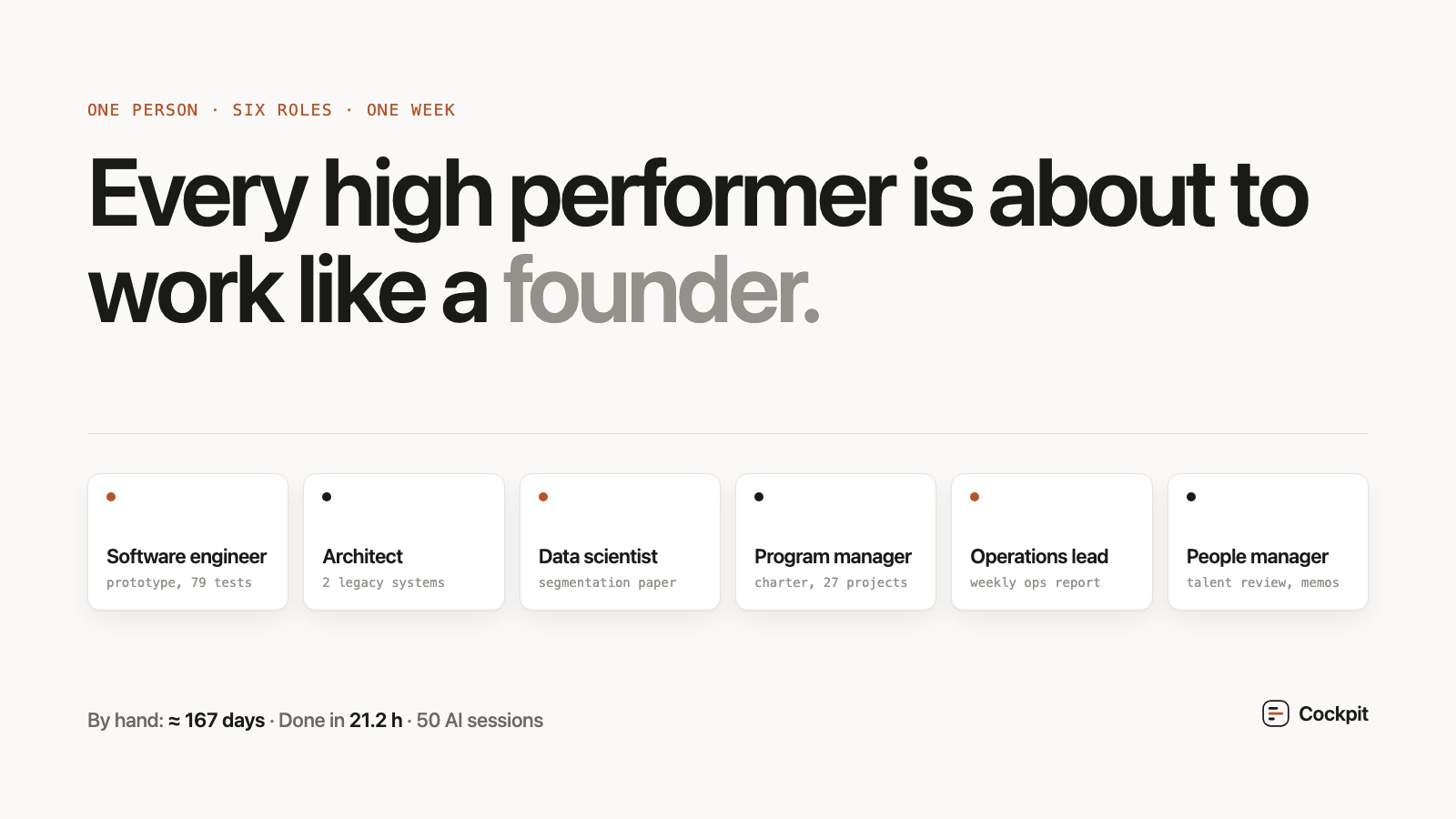
A senior manager said that recently to one of the people using Cockpit. Here is the week that prompted it, from Cockpit's own weekly summary with the company details taken out:
- shipped a prototype API, with 79 passing tests and a user guide, and opened it to five colleagues;
- wrote highly accurate deep-dive architecture documents for two legacy systems, to prepare their replatforming;
- wrote the charter for a new program, and a draft research paper with its deck;
- built a report on how much of the organization's code is now written by AI (the answer was 100%);
- launched a weekly status process for 27 projects, resolved 7 tickets and traced a traffic loss to a single code change;
- prepared a talent review and five promotion memos.
Cockpit estimated that this would have taken about 167 days by hand. It took 21.2 hours of the person's time, across 50 AI sessions, in a week when 70% of their calendar was meetings.
The number is striking, and we're wary of it ourselves. The method behind it is simple and open in the app. But the list is more interesting than the number.
Look at the list again
That week crosses at least six jobs. Software engineer. Architect. Data scientist. Program manager. Operations lead. People manager. In a large company each of those is a separate role, often a separate team, with its own hiring plan, backlog and quarterly goals. Getting all six to move in the same week usually takes a meeting series and a program manager to run it.
Here, one person moved all six. They aren't an expert in every one of them. They know what good looks like in each, direct the agents that do the work, and check what comes back.
That's what a founder does. In the first year of a company, the founder writes the code, talks to customers, hires the first people, writes the board update and fixes the billing bug, often on the same day. Nobody calls it a role. It's the job: whatever moves the company forward this week.
AI agents are bringing that shape of work inside large companies. The high performer, the one who always wanted to do more than their role allowed, can now actually do it.
Work moves up a level or two
When one person can cross that many boundaries, the level of the work changes.
A manager used to be limited to what their team could build in a quarter. With agents, they can do what a director does: run several workstreams across teams, see the system as a whole, and change it. A director can work like a VP or a C-level executive, setting direction across the organization and also producing the analysis, the plan and the first version of the thing that proves it.
Scope used to be capped by headcount and by the walls between functions. Both caps are lifting at once. You no longer need a data science team to get the analysis, an architecture review to understand the legacy system, or a program office to start a program. You need to know what you want, and to be able to tell when you have it.
That's also why the director in the quote didn't understand. The org chart says how much one person can do. It was drawn for a world where every output needed a person to produce it.
A finance firm doing biology
This isn't only about individuals. On a recent episode of The AI Daily Brief, Nathaniel Whittemore looked at Citrini Research, a financial research firm, using AI to design proteins. A finance shop doing biology. The question the episode asks is the same one, at company scale: when expertise can be rented from a model, how far can an organization reach beyond what it was built to do?
Further than its plans assume. Most large companies have a ten-year roadmap that is really a list of things they would do if they had the people. The replatforming nobody has started. The research question nobody has had time for. The program that needs a charter, a dashboard and someone to run it. When the people they already have can each work across six roles, a lot of that list stops being blocked.
We think the companies that take this seriously will do in one year what they planned for ten. The work didn't get easier. The constraint they planned around, the number of people who could do it, went away.
Outcomes, not output
There's a trap here, and it's in our own headline number.
167 days of work is output. Output is now cheap. An agent will happily write a 50-page document nobody reads, a dashboard nobody opens, or a test suite for code that shouldn't exist. If you measure people, or companies, by how much they produce, AI will make everyone look ten times better while very little changes.
What matters is what the work did. Did the replatforming start, and on the right design? Did the traffic loss stop? Did the five engineers get promoted, and deserve it? Did the program change anything for customers?
The scarce thing is no longer the ability to produce. It's judgement about what is worth producing, and the discipline to check whether it worked. That's the founder's habit too: a founder has no use for activity that doesn't move the company.
So a relentless focus on outcomes over output becomes the skill that matters, for everyone:
- For employees: the career advantage goes to the people who pick the right problems and can show what changed. Being able to say "this happened because of my work" is worth more than any count of documents.
- For managers: the job becomes setting outcomes clearly enough that people with agents can run at them across boundaries, and noticing when a team is busy without moving anything.
- For companies: goals, reviews and promotion criteria that count deliverables will be gamed by accident. The ones that measure customer and business outcomes will capture the gain.
What we're building for
This is why we built Cockpit. The person in that week ran 50 AI sessions across six kinds of work. Cockpit is where they ran them from: every session on one board, the ones waiting on them first, and at the end of the week a summary of what it added up to. You can tell that summary what to focus on, such as customer impact, so it reports outcomes as well as activity.
Building the thing and leading the people, in the same week, used to be the founder's life. It's becoming the job description of every ambitious person in a large company. With Cockpit, player-coaching just got a massive upgrade.
Scale yourself with AI. Then make sure it changed something.